
Trousers may seem simple, but their construction is full of purpose and heritage. Each pleat, taper, or fastening comes with a story, often rooted in military uniforms, tailoring houses, or practical innovation from decades past.
Jolliman is built on a foundation of tailoring; our founder trained as a tailor before moving into manufacturing trousers for corporate wear. His sons, the current-day Directors of Jolliman, were introduced to sewing machines from an early age and understand fabric, construction, and design of trousers like most people understand jam goes with scones; tailoring of trousers is in their blood. As such, the foundation of Jolliman is trousers.

In this guide, we explore the purpose, origin, and evolution of trouser details that every well-dressed gentleman should know. Because dressing well isn’t just about style – it’s about understanding the craftsmanship behind what you wear.
Pleats: Comfort with Classic Roots
What they are: Folds of fabric sewn into the waistband to provide extra room at the front.
Purpose: Allows greater movement and comfort, especially when sitting or bending.
History:
- Originating in the early 20th century, pleats became popular in the 1920s–30s as tailoring moved from rigid Victorian silhouettes to more comfortable, functional designs.
- British tailoring houses introduced pleats for riding and military dress, allowing ease in the thigh without compromising shape.
- Still relevant today for their comfort and for the flattering, structured shape they provide, especially for mature builds.
Tapered Legs: Streamlining from the Streets to the Suit
What it is: A narrowing leg from the thigh to the ankle.
Purpose: Creates a sharper silhouette and avoids bagginess around the shoe.
History:
- First seen in military uniforms for practicality and boot clearance.
- Entered mainstream fashion via the 1950s and 60s mod subculture, where neat, ankle-skimming trousers symbolised rebellion and style.
- Gained mass popularity again in the 1990s–2000s, especially in casualwear and suiting.
- Today, tapering is a hallmark of modern tailoring – smart, clean, and universally flattering.
The French Bearer: Hidden Tailoring Excellence
What it is: An internal waistband tab that fastens before the main fly.
Purpose: A French bearer distributes tension and ensures a flat, clean front.
History:
- Originated in traditional French tailoring houses in the early 1900s.
- Adopted by Savile Row tailors as a discreet way to improve the waistband fit and maintain a crisp look under waistcoats or jackets.
- Still seen in quality formal trousers today – rarely noticed, but highly appreciated by connoisseurs.
Turn-Ups: From Muddy Trenches to Gentleman’s Clubs
What they are: Fabric folded up at the trouser hem, sewn in place.
Purpose: Adds weight to help trousers hang better and creates a structured, casual detail.
History:
- Allegedly invented by King Edward VII in the late 1800s, who folded his trousers up to avoid mud.
- By the 1920s, turn-ups became a fashion trend and were associated with country clothing, golfing trousers, and leisurewear.
- Still a feature of heritage menswear, turn-ups lend subtle sophistication to smart-casual and formal trousers alike.
Side Adjusters: Streamlined Function from a Bygone Era
What they are: Waistband tabs with buckles or buttons for adjusting the fit.
Purpose: Allows trousers to be worn without a belt, maintaining a clean waistline.
History:
- Commonplace in bespoke British tailoring from the early 20th century.
- Particularly useful before elastic waistbands or modern belt loops were the norm.
- Faded in the post-war period when belts became the default, but enjoyed a resurgence among modern classic menswear fans.
- Today, they offer elegant practicality, especially on formal trousers. Most modern trousers have replaced the buckle or button with elasticated inserts, some in very discreet ways that the casual observer would never notice – but the wearer would feel the benefits of an expanding waistband whilst sitting, bending, and stretching, or after lunch if bloating is an issue.
Split Waistband (V-Split): The Tailor’s Flex Point
What it is: A small V-shaped notch at the back of the waistband.
Purpose: Adds slight flexibility and prevents strain when sitting.
History:
- Developed by tailors in Savile Row and Europe in the 19th century, when trousers were custom-fit and needed to adapt subtly to movement.
- Once a mark of bespoke construction, it’s now often included in quality ready-to-wear garments.
- A small but mighty detail that sets apart mass-produced trousers from well-considered designs, mainly replaced today by elasticated waist or partially elasticated waist trousers.
Pocket Styles: Designed with Purpose, Styled Over Time
Slanted Pockets
Purpose: Easier access, especially when seated.
History: First seen in military trousers and sportswear in the 19th century, then adopted into suits by mid-century tailors.
Welt Pockets
Purpose: Clean, slimline back pockets ideal for formalwear.
History: A hallmark of Edwardian and post-war tailoring, continuing into modern suiting.
Flap Pockets
Purpose: More secure and structured.
History: Originated in military trousers to protect items during action – now common in country and utility styles.
Coin or Ticket Pocket
Purpose: Originally for change or train tickets.
History: Popularised during the railway boom of the 1800s, especially in riding and city trousers.
These features combine practical heritage with enduring style – each pocket tells a story.
Rise: From High-Waisted Heritage to Modern Comfort
What it is: The measurement from the crotch seam to the waistband.
History:
- Victorian and Edwardian trousers were almost always high-rise, sitting above the natural waist.
- The 1950s–60s introduced lower rises with American denim and youth fashion.
- Today, mid- and high-rise trousers are making a comeback for their comfort and flattering shape.
Tip: A higher rise elongates the legs and avoids that awkward gap when sitting – a true gentleman’s choice.
There can be some confusion with the term high-rise waist, as traditionally a high-rise waist was higher at the back of the trousers than the front. This has become a feature that can be found in some adaptable trouser styles, but is not that common.
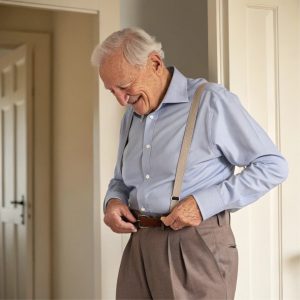
Braces Buttons: The Gentleman’s Suspenders
What they are: Internal buttons for attaching braces.
History:
- Braces were the standard trouser support in the 1800s–early 1900s, before belts became common.
- Buttons were sewn inside the waistband to attach fabric or leather straps.
- Now a classic tailoring detail, especially appreciated by traditionalists and fans of vintage style. With the advent of belts and braces that have clips, this design feature has almost completely vanished from mainstream manufacturing.
Centre Crease: Cutting a Sharp Figure
What it is: The sharp pressed line down the front of the trouser leg.
Purpose: Adds structure, elongates the leg, and sharpens the overall look.
History:
- Became a hallmark of formal tailoring in the early 20th century, especially with the rise of suiting.
- Reinforced the shift from casual wear to structured, business-ready attire.
- Still vital today for suits, uniforms, and any setting where sharp dressing matters.
As a side note: Jolliman offers a service to customers who buy trousers from Jolliman called Superior Crease. This is an in-house service to add a permanent crease to your trousers. A non-hazardous application of a specially formulated solution is run down the seams of the trousers, which gives a permanent crease that not only makes you look smarter, it also lasts the lifetime of the garment. Ideal for those seeking a permanent crease on trousers and pants, or trousers with a crease for a consistently sharp look. Our Superior Crease is the permanent crease for your garment.
Lined Trousers
Lined trousers date back to tailored menswear traditions of the early 20th century, when linings were used to give garments a smoother drape and protect the outer fabric from wear. Typically made from lightweight materials such as polyester or viscose, full linings run from the waistband to the hem.
Benefits:
- Enhanced comfort: Reduces friction against the skin and prevents chafing.
- Improved warmth: Offers an extra layer of insulation, ideal for cooler months.
- Longer lifespan: Protects the outer fabric from perspiration and stretching, helping trousers maintain their shape.
Part-Lined Trousers
Part-lined trousers usually feature a lining from the waistband to just below the knee. This style emerged as a practical solution for gentlemen who needed a smarter appearance without sacrificing breathability, especially in warmer climates or during more active use.
Benefits:
- Breathable and lightweight: Ideal for all-season wear without causing overheating.
- Targeted comfort: Focuses on areas where rubbing and discomfort are most likely, such as the thighs.
- Better freedom of movement: Less fabric means less restriction.
Taped Seams
Taped seams involve sealing or reinforcing the inside of the seam with a narrow strip of tape, often used in outerwear and high-performance garments. Originally developed for military and outdoor wear to provide waterproofing, this technique has found its way into high-quality casual and formal trousers for added structure and comfort.
Benefits:
- Improved durability: Reinforces areas most prone to stress and wear.
- Prevents fraying: Helps maintain the integrity of the seams over time.
- Cleaner finish: Offers a neater interior look, particularly important in unlined or partially lined garments.
In Summary, Dressing Well Is Knowing What You’re Wearing
Trousers are more than just fabric and fit. They are the product of centuries of design evolution, rooted in utility, military history, and classic tailoring. When you understand what features like pleats, side adjusters, or a French bearer do, you start to dress not just with style, but with intention.
At Jolliman, our trousers are made with these principles in mind: reassuringly similar to the classics, updated for modern comfort. Whether you favour timeless tailoring or practical daily wear, it pays to know your pleats from your turn-ups.
Because in menswear, it’s the quiet details that make all the difference.




Leave a Reply
You must be logged in to post a comment.